Mina, where the hell have you been, loca?

I’ve tried to write this post a couple of times now, trying to be funny and carefree, but it never felt quite right to hit that light blue post button. Yet, WordPress keeps reminding me I have drafts and notifications, so I’m trying again, trying to make it exist again before making it good.

Hi everyone, and welcome back to Science Pit!

Since my last post, I spent one year teaching, one year at Yale Neuroscience, and I’m now finishing the second year of my PhD Fellowship at UiT – The Arctic University of Tromsø. 

With time, my idea of this blog also changed; initially, I envisioned it as a platform to primarily share cool science facts and information I found interesting, but now I think I might put that on the back burner and share more of my PhD life and research. Perhaps, I think, it’s time to go back to basics: personal blogs, slow reading, silly videos, and enjoying life.

I have been promising a YouTube channel for ages now, without a clear vision on what to post and how to make it aesthetically pleasing and interesting, overthinking and overanalysing every shadow, colour bleed, and my accent and the topic I’m covering, and bla blah bla… Realising I’m stressing myself out over… nothing really, I kinda sorta gave up on that part, to have something polished and sleek, especially because I always liked that super-personal aesthetic of the early 2000s and 2010s.

With that in mind and constantly being bombarded by misinformation and terrifying (eco) information, I finally landed on a topic for my first video: the sixth R in reduce, reuse, recycle, rethink, refuse, repair.

I feel that (some) media channels are almost fear-mongering about all the scary stuff we are surrounded by, like PFAS, and natural catastrophes like wildfires and floods. Don’t get me wrong, it’s extremely important to be aware of these things and know how to prepare, but when that is the only thing being written about, it can quickly lead to mental fatigue and unconscious avoidance of eco topics. 

It’s easy to start feeling helpless, just another insignificant cog in the capitalistic machine, unable to change the system. Many of you who follow me on social media are already aware of my opinion that the greatest lie the devil capitalism created was that consumers are responsible for global warming and just every other (un)natural disaster they want to pin on someone else.

So, what can you we do?

To me, it’s so easy to repair my clothes and even some smaller electronics with whatever I have on hand, but I realised that a skill like that is learned and that many guides overcomplicate things. Sometimes, they even make things seem a little scary, or like we need to get more things (often a glittered-out sewing machine is included) or teach tricky techniques and knots. 

Especially now living in Norway, where people prefer mending in lieu of buying new, I wanted to share how I mend the stuff I own and how my journey on a no-buy challenge (new clothes) is going so far.

The other topic that has been bugging me (pun intended) is reading. Am I crazy, or did social media take all the joy out of reading and sharing your impressions, tidbits, and criticism? Everything is a fuckingcompetition now: how many books you read, how fast, how quickly you post about them, how many books can you performatively stuff in your fast-fashion book bag. Social media turned reading into a performance, and a very bad one at that.

Slow reading is reading. Reading one book a year is reading. Audiobooks are reading. Reading essays and articles is reading. Sharing about what you read and how it made you feel, good or bad, is encouraged and welcomed. Or at least, it absolutely should be. 

What I’m trying to say is that I’m starting a book podcast. 

I know, I know, but this time I’ll keep up with it, I promise. I’ll post and record and interview and edit, and Spines & Vibes will be known around the globe in no time. I know, I know, I don’t have the best track record, but I have to this time, because otherwise I’ll be a bad friend who made my best friend make a logo that will go unused, and I really really can’t be that friend.

Wait, didn’t I open this whole post by saying I’ll share more about my PhD life? Well… I am currently at an academic writing retreat working on my first manuscript… By writing a blog post… At least it’s the thought that counts?

So long, my friends, and let me know what happened with all of you in the last three? four? years. 

My next blog post is coming in three years next week-ish.
And the video soon-ish too.

Why I quit Duolingo.

Many of you, especially if you follow me on social media, are aware of my long devotion to Duolingo and its streak. I’ve been using it as a refresher for vocabulary, a guide on how to write certain letters outside of the Latin alphabet, and I’ve also attempted to use it to learn a new language, in this case Norwegian Bokmål. At one point, I was relying on the annoying green bird so much that I even bought a premium for two years, before completely abandoning the platform.

Too cool for school, or whatever the youth is saying today

I like the idea of Duolingo, just as I like the idea of any other free, educational platform that is well-researched and well-supported. I think Spanish was the first language I tried to learn on Duolingo, a good decade ago, when, in addition to tasks, you also had written grammar lessons you could read. It was a promising platform with a quirky mascot, not plagued by too many ads and shrouded in a carefree sentiment of learning the language easily and differently.

I stayed loyal to Duolingo through multiple changes and additions, some for better, some for worse, until I started to notice that, as a complement to a language whose basics I was already familiar with, it functioned great. But as a platform to set you up with a new language, for me, it was failing, and it was failing hard.

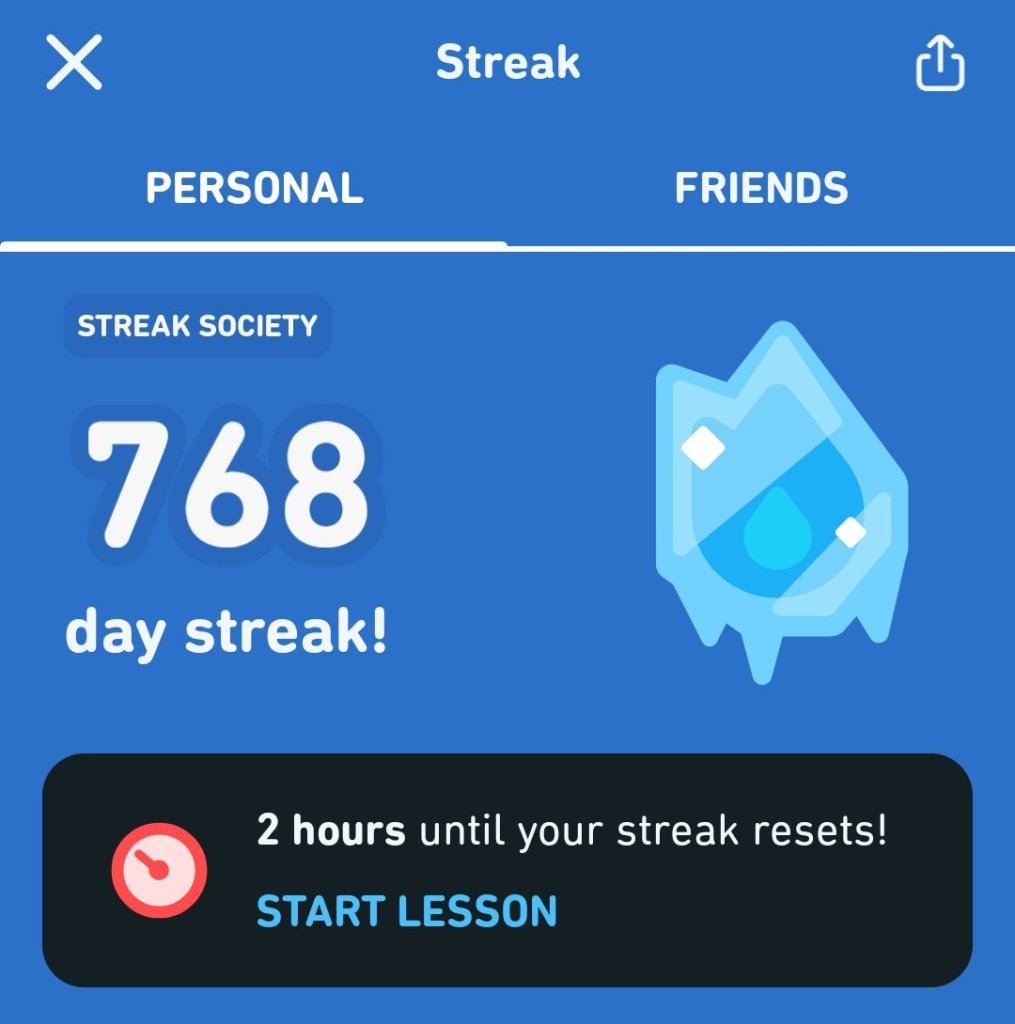
My streak on the day when I deleted the Duolingo app from my phone

Initially, I thought that if I put more time into it, it would work out, but in the end, I had to admit my defeat. When I was still toying with the thought of abandoning the platform completely, news came out about Duolingo’s move to replace many of the manual, human content creation with AI.

“One of the best decisions we made recently was replacing a slow, manual content creation process with one powered by AI,” co-founder and CEO Luis von Ahn said in the letter, shared on LinkedIn. “We’d rather move with urgency and take occasional small hits on quality than move slowly and miss the moment.”

Words cannot describe how much I hate every aspect of this, and although I wasn’t quite surprised (we live in the “golden” age of AI, after all), I was disappointed enough to abandon the platform and redirect my focus to other self-learning resources, which, luckily for me, are abundant on the World Wide Web.

I found specialised courses for all the languages I strive to learn, and now focus more on smaller creators as well, both on social media and YouTube. I try to think back when I was initially learning English, what was most helpful to me, and it always comes back to writing on my own and becoming obsessed with film culture. In the end, it also boils down to my time as well, as I prefer to do everything at my own pace, not on the beating drum of an overgrown green monster.

If Duolingo works for you, I applaud you, but I judge you just a smidge as well (I am from Balkan, after all, it’s my cultural heritage). And if you found other platforms that align more with the sentiments I expressed here, please let me know which ones you are using and how they are working out for you.

Until next week,

With my last brain cell,

xoxo Mina