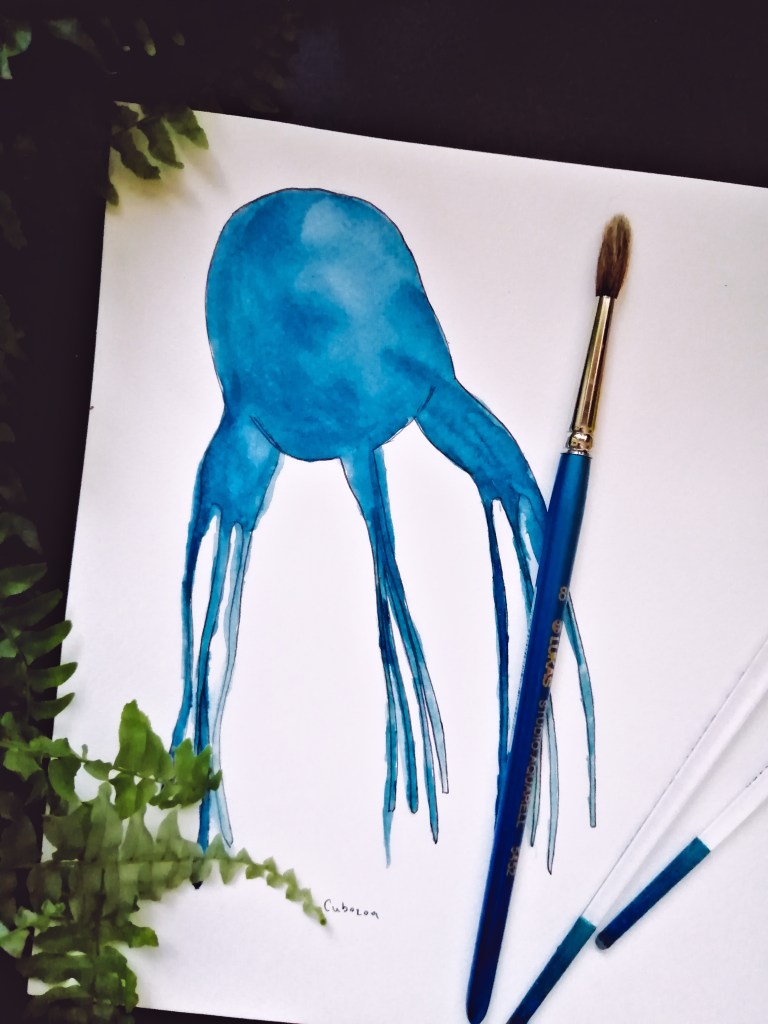
Cubozoa, or box jellyfish, are another cnidarian class. Their name stems from their distinct cube-like shape. Cubozoa are also distinct from other cnidarian because their venom can be fatal to humans. As with all cnidarians, box jellyfish have two nerve nets and, like Scyphozoa, rophalia. However, box jellyfish also have a distinct nerve ring, as well as more developed eyes that consist of a lens, cornea, pupil, and a layer of retinal cells. Altogether, Cubozoa have 24 eyes, which makes them the most advanced cnidarian class in the sensory aspect.
Rophalia are mutually connected via the mentioned nerve ring. This ring is believed to be an integration center for the swimming, visual, and tentacle systems; it is comprised of oversized neurons, as well as some smaller neurites. The communication between the nerve net and jellyfish muscles is regulated by chemical synapses.
Most of the information relating to Cubozoa, I already mentioned in the previous post about Scyphozoa, so I only wanted to relay the main differences between the two. These two classes are so similar that, until recently, they were actually considered one class.
I already wrote couple of posts on this topic, and today I’m focusing on several examples from movies and TV shows I’ve recently watched. The movies I’m going to write about are Lara Croft: Tomb Raider – The Cradle of Life, The Good Liar, Charlie’s Angels (2019 version), and Paranoid TV show. So, if you are planning to watch those, just a warning that there will probably be spoilers below!
Let’s start with the obvious and amusing misportrayal: in Lara Croft: Tomb Raider – The Cradle of Life (2003 movie), Lara is riding sharks in the opening sequence. I think no one would believe this is actually possible, but shark petting videos recently became very popular. However, many researches are strongly discouraging this type of behaviour.
The Good Liar (2019 movie) is an interesting thriller with really good cast that I actually enjoyed. Without giving out too much of the plot, I’ll just mention one scene where Helen Mirren’s character gives the haircut to the character played by Ian McKellen. She uses cut hair for the DNA analysis, factually linking McKellen’s character for the past crimes. Of course, we all know that without the root, there is no DNA to analyze, right? Not quite. Most companies that do DNA analysis require hair with follicles in order to extract DNA for analysis; however, they mostly deal with paternities, so they need the nuclear DNA. Mitochondrial DNA, on the other hand, apparently can be extracted from the hair itself. For the movie’s purposes, I think nuclear DNA was needed, so this seems like a movie mistake. But, recently scientists did manage to successfully extract nuclear DNA from rootless hair, but that DNA is often fragmented and complicated to extract. I would also just like to mention that I believe this movie explains trauma and coping surprisingly well for a Hollywoood movie.
In Charlie’s Angels (2019 movie), which I hoped would be more enjoyable than it was, a very interesting premise was introduced; in order to effortlessly communicate, members of the team get a certain tattoo (at least I think it’s a tattoo, but don’t 100% quote me on that) and they can hear thanks to it. So, my first thought was, wow, they really went sci-fi on this one, but it sounded too out there. And then I remembered bone conduction. Simply, bone conduction allows you to hear the transmission, without blocking the outside sounds. And yes, only you can hear it. There are headphones already in use for this type of thing, and they can be also used to help with some kinds of hearing impairments. These headphones are placed on the skull, and I haven’t seen it implemented in a tattoo yet, but it’s actually a neat idea.
Paranoid (2016 TV show) is, in my opinion, really bad, despite only tangential connection to Biology. This show feel anti-medication and anti-psychiatrists, portrays them in a very bad light, and chooses not to mention how much medications and psychotherapy are actually helping people. The premise is also built on one of the cliche “anti-big pharma” representations. I was honestly insulted, despite not working in any of these fields. There is a also a subplot concerning a female character who had provocative photos of her taken 15 years ago, and she is not longer in possession of said photos; she is blackmailed with the possibility of leaking those. Her love interest immediately accuses her of things I won’t write here, but you get the main idea. I mean, am I the only one who sees this as highly problematic This TV show is doing some serious damage to the health care, it is insulting to physicians, it is insulting to patients, and I honestly can’t believe that no one during the whole production didn’t say anything.
I hope you like these kind of posts, because I already have enough material for another one (there are a lot of Biology & science mistakes on the big screen). What is your favourite movie mistake related to Biology?
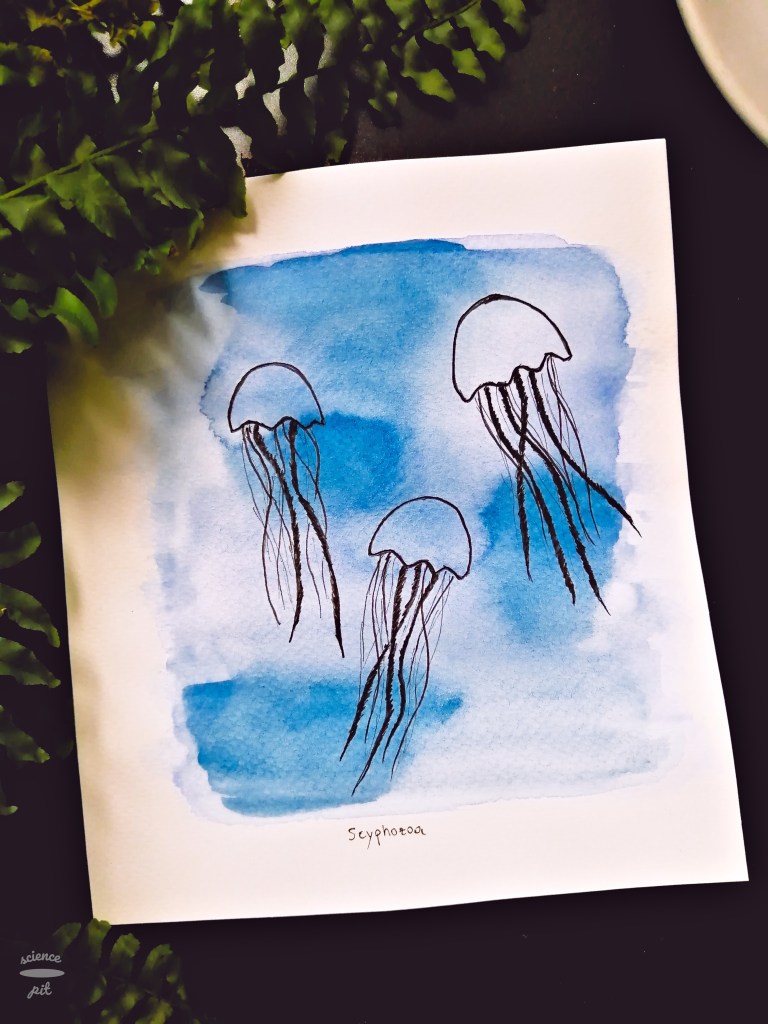
Scyphozoa (true jellyfish) are much more interesting (in a neurobiological way) than previously described corals. One major difference is that Scyphozoa are pelagic animals, which means they are not fixed to the ground. They also have two diffuse nerve nets (subepidermal and subgastrodermal) that consist of bipolar and multipolar neurons – the impulse conduction has been measured at 0,15 m/s. Both nets coordinate the movements of an animal towards the food. Some scientists, however, differentiate one diffuse and one motor nerve net. The motor net is in charge of the activation of muscle contractions after receiving signals from the so-called pacemaker organs (which are in charge of the swimming rhythm). The diffuse net, in this case, is in charge of marginal tentacle contraction and it is also believed it communicates sensory information to jellyfish musculature. Neurons of the motor nerve net are connected by chemical synapses, while neurons of diffuse nerve net are connected by peptidergic synapses that were noted in Anthozoa as well.
Sycphozoa also have much more developed sensory organs than any of the animals previously mentioned. These sensory structures are called rhopalia and they are located on the edges of the jellyfish bell – there are usually four of them (or a number that’s a multiple of four). Rhopalia contain multiple sensory receptors – statocyst (balance receptor), ocelli (light sensitivity), a mechanoreceptor, a chemoreceptor, and aforementioned pacemaker neurons.
I would also like to note here that some authors (I’m referring here to the article “Do jellyfish have central nervous systems?” by R. A. Satterlie) believe this kind of nerve net explanation is rather simplified and that there exist some evidence suggesting that jellyfish have a centralized nervous system, mainly that rophalia are in fact rudimentary ganglia and could be regarded as integrative centers. However, any communications between rhopalia themselves exist only through the nerve nets.
I don’t know about you, but I just love doing online courses, especially when they deal in subjects I don’t get to explore in my college courses. Over the years, I tried many different platforms, such as YouTube, Google Digital Garage, Khan Academy, Udemy, and, my favourite, Coursera. As a matter of fact, I discovered Coursera back when they started in 2012; most of the courses I took were on topics of Neuroscience and Molecular Biology. At first, courses and certificates were completely free, but with time, they started offering paid vs. free, as well as many specializations and even some college degree courses. However, many of the courses are still available to watch and do quizzes, just without the certification.
Disclaimer: this post is not sponsored by Coursera.
This course, offered by Hebrew University of Jerusalem, is actually the very first course I took, and at the time was one of the rare Neuroscience courses. I have only good memories about this one – it is a good introductory course into the field and the professor explained the curriculum very well. Also, the course mentions real projects that deal with neural networks and brain reconstructions, such as Blue Brain Project. I didn’t mention this previously, but every course also comes with subtitles (in English at least) and transcripts, so you can follow along easier.
The Addicted Brain (by Emory University) is another course appropriate for beginners in this topic – I was initially interested not only because of the topic of addiction, but also because various mechanisms of how drugs interact with the brain were presented. The course also covers the topic of drugs in society, although this part mainly concerns United States of America. Also, I don’t know if this is something that’s important to you, but I followed professor’s narration easily – his voice is calming and he speaks very understandably.
Medical Neuroscience (by Duke University) is not only the most advanced course of the ones mentioned here, but the most advanced course I ever took. Actually, I started it once or twice before, but dropped out because it required a lot of time and dedication that, at times, I just didn’t have due to my University obligations. This course is really extensive and requires some before-knowledge, but is also very satisfactory when you finish it. The only problem I had with this one is that sometimes I felt that questions in quizzes were asking for details that to me seemed almost overlooked in the videos. However, I felt like this course was quite important for my studies, since I have a strong interest in Neuroscience, but lacked the medicinal perspective.
All quizzes are multiple choice answers, with usually one correct answer (sometimes more correct answers). I vaguely remember some questions where you had to connect some phrases (like 1-d, 2-c, etc) as well, but haven’t came across those recently. Also, the quizzes I did were never timed and you can take one quiz 3 times every eight hours (they keep your highest score).
Coursera also offers financial aid – you can fill out an application where you explain why is the course you’re applying for important to you and why you can’t afford it. So far, I’ve heard of many positive experiences where they gave grants.
There are also two Neuroscience related courses I am planning to take – Human Neuroanatomy (to revise a bit) and Computational Neuroscience, which deals with using Python in Neuroscience research. I would very happily review those for you, in a greater detail, if this is something you’d like to read about!
***
What is your opinion on online courses – do you think they’re useful or a waste of time? Did you perhaps take some of the ones I mentioned? If yes, I would love to hear from your!
Anthozoa (corals & anemones) are interesting animals that live exclusively in seas and oceans. Since they are regarded as sessile organisms, their nervous system is not very advanced. In a previous post, I mentioned that all cnidarians have two diffuse neural nets, and that is true for Anthozoans as well. Multipolar nerve net neurons are connected with synapses, and they also possess sensory cells that are particularly numerous around the mouth and on the tentacles.
One paper investigated traveling of electrical waves in a coral nerve network in coral colonies in genus Palythoa. It was experimentally observed that this electrical wave spreads at the constant speed from the site of simulation. Furthermore, peptidergic neurons (the ones using neuropeptides to communicate) were also noted in Anthozoa.
Did I draw this when I was 5 or 25? – A mystery.
Nematostella vectensis, also known as starlet sea anemone, is a species of Anthozoa that is known as a model organism – its genome and development have been carefully studied, including its nervous system. In this species, oral and pharyngeal nerve rings have been reported, as well as longitudinal tracts of neurites (neurites are usually axons or dendrites). These findings would suggest that some groupings of neural cells exist in at least some Anthozoan species after all. Sensory neurons, interneurons, motorneurons, and neurosecretory‐like gland cells were also reported to exist in N. vectensis.
Note: in case I didn’t mention this before, cnidocytes are often considered neural cells because they display mechanosensory properties and calcium dependent neural‐like properties as well.






 science-pit.blog